
Methodology that travels
Registered-valuer reports and fair-value opinions across the regulatory canvas — Companies Act, FEMA, Income Tax, SEBI, and Ind AS
Starting points
Fundraise
You are raising capital through equity or equity linked instrument issue
See how →M&A and restructuring
You are executing a merger, demerger, slump sale, buyback, or business reorganisation
See how →ESOP grant
You are granting ESOPs or sweat equity to employees, directors, or advisors
See how →Financial reporting
You need a fair value report to support your audit, financial statements disclosure, or Ind AS compliance
See how →AIF portfolio
You are managing an Alternative Investment Fund and need periodic portfolio valuation report
See how →The full service offering
Transaction Valuation
For deal-driven valuation needs
See the full list →- Business valuation
- Equity valuation
- Mergers and demergers
- Slump sale
- Share swap
- Buyback
- Convertible instrument valuation (CCPS, CCD, OCRPS, convertible notes)
Regulatory Valuation
For statutory and regulatory compliance
See the full list →- Companies Act
- FEMA / FDI / ODI
- Income Tax
- SEBI
Financial Reporting Valuation
For audit, financial statements disclosure, and Ind AS support
See the full list →- Purchase price allocation
- Intangible assets
- Financial instruments
- Impairment testing
- ESOP cost
- AIF portfolio
Scoping to finalisation
Scoping
Purpose, valuation date, and regulatory framework confirmed. Engagement letter signed.
Information request
An information request list is shared, covering financials, projections and other requirements.
Data review
Data reviewed, follow-up queries raised, management discussions held where needed.
Analysis
Method selection, application of the chosen approaches, and reconciliation of results.
Draft report
Draft report shared with the company for factual review.
Finalisation
Factual revisions incorporated. Final UDIN-compliant report issued.
What makes the work different
Multi-regulatory fluency
Valuation reports across the Companies Act, FEMA, Income Tax, SEBI, and Ind AS, through a single point of contact
Engagement led by senior professionals
Qualified professionals stay closely involved from scoping through to the signed report
Multi-disciplinary group
CA, CS, CMA, and LL.B. expertise across the team. A valuation rarely sits on its own; the tax, legal, and secretarial consequences of the number are read alongside it
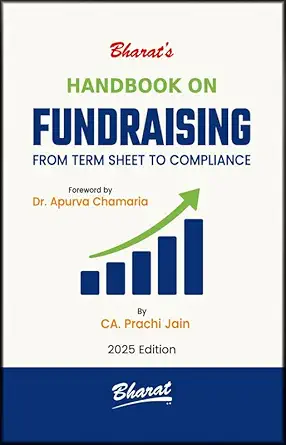
Handbook on Fundraising: From Term Sheet to Compliance
By CA Prachi Jain. A practical guide for private companies raising capital through equity shares and equity-linked securities such as CCPS and CCDs.
Read more in the Knowledge Centre →Frequently asked questions
Foundations
- Companies Act, 2013
- Section 42 read with Section 62 — preferential issue and private placement
- Section 54 — sweat equity
- Sections 230 to 240 — schemes of arrangement (mergers, demergers, reconstructions)
- FEMA / Non-Debt Instruments Rules, 2019
- Issue or transfer of shares between residents and non-residents, or between two non-residents
- Outbound investment by an Indian resident
- Income-tax Act, 2025
- Section 79 (successor to Section 50CA of the Income-tax Act, 1961) — inter alia deems fair market value as the full value of consideration where a transferor sells unquoted shares below FMV
- Section 92(2)(m) (successor to Section 56(2)(x) of the Income-tax Act, 1961) — inter alia taxes a transferee on shares received below fair market value
- FMV under both provisions is determined per Rule 57 of the Income-tax Rules, 2026 (successor to Rule 11UA of the Income-tax Rules, 1962)
- SEBI regulations
- Regulation 166A of the SEBI (Issue of Capital and Disclosure Requirements) Regulations, 2018 — preferential issue by a listed company involving a change of control, or allotment of more than 5% of post-issue fully diluted capital
- Regulations 8 and 9 of the SEBI (Substantial Acquisition of Shares and Takeovers) Regulations, 2011 — open offers involving infrequently traded shares
- Regulation 23 of the SEBI (Alternative Investment Funds) Regulations, 2012 — periodic portfolio valuation
- Ind AS / financial reporting — An independent valuation report substantiates fair value measurement under Ind AS 113, Ind AS 103, Ind AS 36, and Ind AS 109, for financial statements and audit review.
- Companies Act, 2013 — Section 247 read with the Companies (Registered Valuers and Valuation) Rules, 2017 requires valuations under the Act to be issued by a Registered Valuer registered with the Insolvency and Bankruptcy Board of India (IBBI).
- Income-tax Act, 2025
- For unquoted equity shares, fair market value is arrived at under the formula prescribed in Rule 57 of the Income-tax Rules, 2026.
- For unquoted shares and securities other than equity, the value may be certified by a merchant banker or an accountant.
- FEMA / Non-Debt Instruments Rules, 2019 — Pricing certifications may be issued by a Chartered Accountant, a merchant banker, or a practising Cost Accountant.
- SEBI regulations — The position shifted at the end of 2025. By notifications dated December 3, 2025, effective from January 2, 2026, SEBI amended the SEBI (Substantial Acquisition of Shares and Takeovers) Regulations, 2011 and the SEBI (Share Based Employee Benefits and Sweat Equity) Regulations, 2021 to require a registered valuer's report in place of a merchant banker's.
- Registration is granted in one of three asset classes: Land and Building; Plant and Machinery; and Securities or Financial Assets.
- The Securities or Financial Assets class covers shares, debentures, other securities, financial instruments, intangibles, and businesses.
- A Registered Valuer must comply with the Code of Conduct under the 2017 Rules, meet continuing professional education requirements, and remain independent of the subject of the valuation.
In practice
- Income approach — Values an asset on the present value of its expected future economic benefits. Best suited to going concerns with reasonably projectable cash flows. Some of the methods under this approach are:
- Discounted Cash Flow (DCF) — the most common method, with variants including free cash flow to firm (FCFF) and free cash flow to equity (FCFE)
- Market approach — Derives value from comparable companies or transactions. Best suited where sufficiently comparable peers or transactions exist. Some of the methods under this approach are:
- Comparable Company Multiple — applies multiples such as EV/EBITDA, EV/Revenue, or P/E from listed peers
- Comparable Transactions Multiple — applies multiples from recent comparable deals
- Cost / Asset approach — Values an asset on its net asset value, assets less liabilities, typically restated to fair value. Most commonly applied to asset-heavy businesses, holding entities, and liquidation or wind-up scenarios.
- The choice of approach depends on the nature of the asset, the purpose of the valuation, the regulatory framework, and the reliability of inputs, guided by international standards (such as IVS and the IPEV Guidelines) alongside Indian regulatory provisions.
- Scoping — Purpose, valuation date, regulatory framework, and scope of work confirmed; engagement letter signed.
- Information request list — Shared with the company, covering:
- Audited financials and latest unaudited financials
- A business description
- Projections (where the income approach is used)
- The capitalisation table and shareholding pattern
- Charter documents
- Any prior valuation reports
- Data review and queries — Data reviewed, follow-up queries raised, and management discussions held to understand business drivers, assumptions, and risks.
- Analysis — Method selection, application of the chosen methods, and reconciliation of results where more than one method is used.
- Draft report — Shared with the company for factual review; the substantive valuation conclusions remain independent.
- Finalisation — Factual revisions incorporated and the final valuation report issued.
- Engagement details
- Identification
- Valuation date
- Basis of engagement
- Appointing party
- Scope and limitations
- Purpose
- Regulatory framework
- Data relied upon
- Any carve-outs
- A description of the subject — business, ownership, operations
- Industry and economic context, where relevant
- The valuation methodology — approaches considered, methods selected, and the rationale
- The key assumptions — discount rates, growth rates, terminal value, comparables
- The valuation calculation
- The valuation conclusion — per share, enterprise value, equity value, range, or point estimate, as the engagement requires
- Annexures with supporting schedules